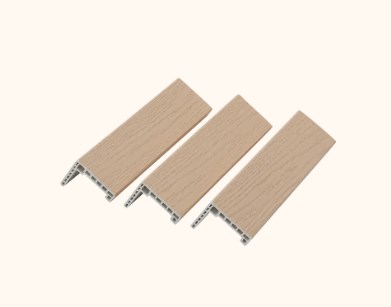
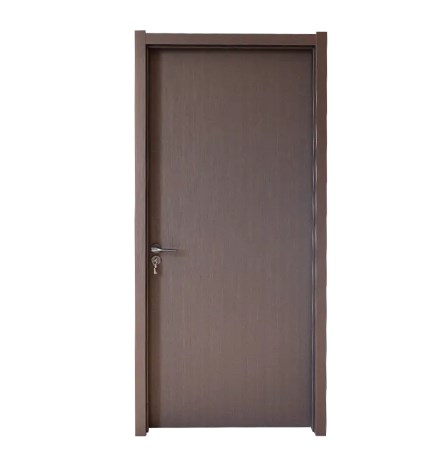
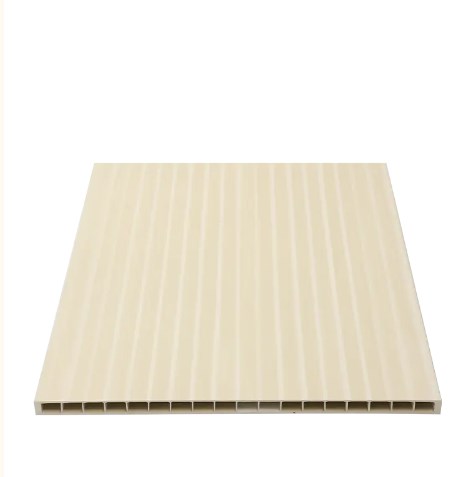
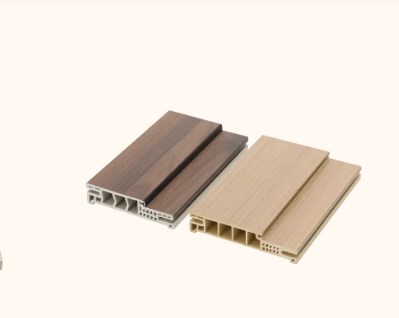
WPC skirting line, also called wood plastic composite baseboard, refers to the special decorative profile laid along the junction of wall and floor inside buildings. The core raw material system of this product takes plant fiber such as wood flour and bamboo fiber as the main filler, matched with thermoplastic polymer resin, and adds a small amount of auxiliary additives for mixing, high-temperature melting and one-time extrusion molding. This production process combines the visual texture of natural timber and the stable physical stability of plastic materials, solving many inherent defects of single raw material skirting products.
The proportion matching of raw materials directly determines the comprehensive performance of finished WPC skirting line. Standard qualified products control the fiber proportion within a reasonable range, which can avoid two extreme problems. If the plant fiber content is too low, the surface texture will be too rigid and lack the warm decorative sense of wood; if fiber accounts for too much, the finished product will be prone to water absorption expansion and structural looseness in long-term humid environment. Professional manufacturers balance the two core raw materials to form a compact internal molecular structure, so that the finished skirting can maintain stable size under different temperature and humidity changes.
Auxiliary agents added during production include anti-ultraviolet stabilizers, mold inhibitors, lubricants and color fixing agents. These additives do not change the basic texture of WPC skirting line, but greatly expand its application range. For example, mold inhibitor components can effectively restrain the breeding of mildew and bacteria on the surface, while anti-UV additives reduce the risk of color fading when used near windows with long-term sunlight exposure. All auxiliary materials adopted by mainstream environmental protection WPC skirting comply with indoor decoration safety standards, and will not release harmful volatile substances after long-term indoor placement.
In indoor decoration construction, solid wood skirting, pure PVC skirting and metal skirting are three traditional mainstream choices. WPC skirting line gradually replaces these materials in many decoration projects because of balanced comprehensive performance. The following table intuitively sorts out the core performance differences of several common skirting products, so that decoration practitioners and home owners can quickly judge material applicability according to their own scene demands.
| Performance Item | WPC Skirting Line | Solid Wood Skirting | Pure PVC Skirting |
|---|---|---|---|
| Moisture & Waterproof Capacity | Excellent, no water absorption swelling | Poor, easy to expand & crack | Good, but low structural hardness |
| Anti-Mold & Anti-Insect | Strong, no moth damage risk | Weak, easy mold & termite erosion | Medium, chemical smell may appear |
| Surface Texture | Natural wood grain touch | Real wood texture, easy wear | Plastic rigid sense, single style |
| Long-Term Deformation Resistance | Stable, little thermal expansion | Unstable, warp in temperature change | Easy to soften under high temperature |
Many indoor spaces such as kitchens, independent bathrooms and basement storage rooms have persistent high humidity environment. Solid wood skirting used in such areas will absorb moisture from air and ground within a short period, leading to local bulging, surface paint peeling and internal mildew accumulation. Even after surface waterproof paint treatment, the service life can only be maintained for a short time. WPC composite material forms a dense water-isolation layer inside after high-temperature extrusion, water molecules cannot penetrate into the internal structure of the profile. Practical decoration cases show that WPC skirting installed in household bathrooms can keep intact appearance and stable size for many years without mildew marks on the surface.
Solid wood skirting needs multi-layer paint spraying for anti-corrosion and color fixation, and paint layer will continuously release volatile organic compounds in the use cycle. Low-cost pure PVC skirting may add recycled waste plastic raw materials, which will produce pungent peculiar smell when encountering high temperature in summer. Standard WPC skirting line adopts integrated color mixing technology in the production stage, no post-spray paint process is needed, and the raw materials do not contain formaldehyde and heavy metal components. It can be put into normal use immediately after installation without long ventilation period, which greatly shortens the waiting cycle of indoor occupancy after decoration.
The bottom skirting of walls is often collided by furniture legs, cleaning tools and children’s toys in daily life. Solid wood skirting is easy to leave deep pits and scratches after impact, and the damaged position cannot be self-repaired, requiring whole section replacement. Pure PVC skirting will crack under heavy impact force. WPC material has moderate toughness and hardness balance, slight collision will not leave obvious traces, even if there are shallow scratches accidentally, it can be covered with matching color repair paste, reducing later replacement and maintenance cost.
Due to balanced waterproof, anti-mold and decorative performance, WPC skirting line can adapt to almost all indoor decoration scenes, and it also has unique advantages in some special humid and multi-scene public spaces. The main applicable fields are divided into residential interior decoration and commercial space decoration two major categories, with detailed scene classification as follows.
There are very few scenes not suitable for WPC skirting line. The only limitation is long-term fully outdoor open-air environment with continuous rain and frost, because the superposition of strong wind, frost and rain will accelerate the aging of surface auxiliary layer. For semi-open corridors with partial sunshade and rain isolation, WPC skirting can still maintain stable use state for a long time.
The installation difficulty of WPC skirting line is lower than solid wood skirting, and it supports two construction schemes of adhesive pasting and fixed keel installation according to wall base condition. The whole set of operation flow does not need complex professional tools, and home owners can complete simple self-installation with basic hand tools. The complete standardized operation steps are sorted by digital sequence as below.
A key installation tip to extend service life: reserve tiny expansion gaps at the splicing joints of each skirting section. WPC materials still have slight thermal expansion and cold contraction characteristics under extreme temperature difference. Reserved gaps can avoid mutual extrusion deformation between adjacent skirting sections in high temperature summer environment.
One core advantage of WPC skirting line is ultra-low maintenance cost in long-term use. It does not need regular waxing, paint touch-up and anti-insect treatment like solid wood skirting, and only simple daily cleaning can keep its surface intact for years. The maintenance work is divided into daily routine cleaning and occasional scratch repair two parts.
Shallow scratches only damaging the surface color layer can be repaired with matched color repair wax block, simply rub the wax block back and forth along the scratch trace, then polish excess wax with soft cloth, the scratch trace will be basically covered. Deep scratches penetrating the internal structure need to cut off the damaged small section and replace with new skirting segment, the splicing position can be hidden at wall corners to weaken visual traces.
Matters needing attention in maintenance: do not scrub WPC skirting surface with hard steel wire ball, hard metal cleaning tools will produce dense irreversible scratch marks on the composite surface; do not place high-temperature objects such as hot pot bottom and hot water kettle close to skirting line for a long time, persistent high temperature will accelerate local surface aging and color change.
Under standard indoor use environment and correct installation maintenance, qualified WPC skirting line can maintain stable decorative performance for more than fifteen years. The actual service life will fluctuate according to raw material quality, installation specification and use environment three major factors, each factor has obvious impact on long-term use effect.
Low-cost inferior WPC skirting adopts a large proportion of recycled waste plastic and excessive filler powder, lacking sufficient anti-ultraviolet and anti-aging additives. Such products will appear surface chalking, serious color fading and brittle fracture within several years. High-quality finished products adopt new pure raw materials and complete additive system, anti-aging components can delay the oxidation speed of internal molecular structure, greatly prolong the usable cycle.
If installation workers cut corners during construction, such as omitting expansion gaps, using inferior adhesive and mismatching corner accessories, the skirting line will crack, fall off and deform within a short time after putting into use. Strictly following standardized installation steps can eliminate hidden dangers of structural damage in advance, and maximize the design service life of WPC skirting products.
Dry rooms with weak sunlight have the mildest aging influence on WPC skirting. Spaces with all-day strong sunlight or perennial high humidity will accelerate material aging speed, but even in such harsh indoor environments, qualified products can still reach more than ten years of normal service life, which is far ahead of solid wood and ordinary PVC skirting materials under the same environment.

 English

 English
 عربى
عربى Español