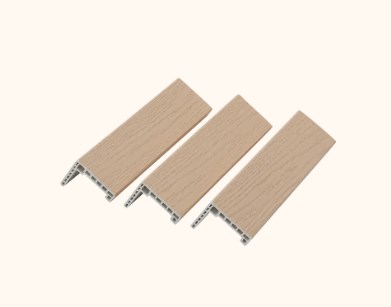
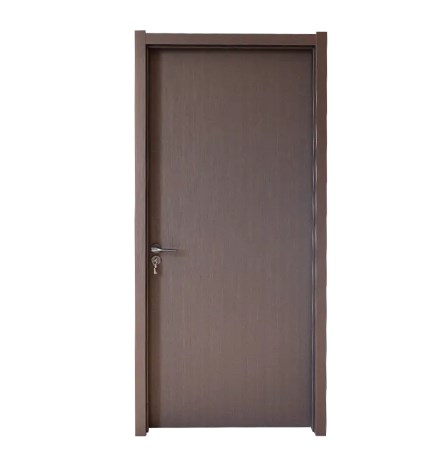
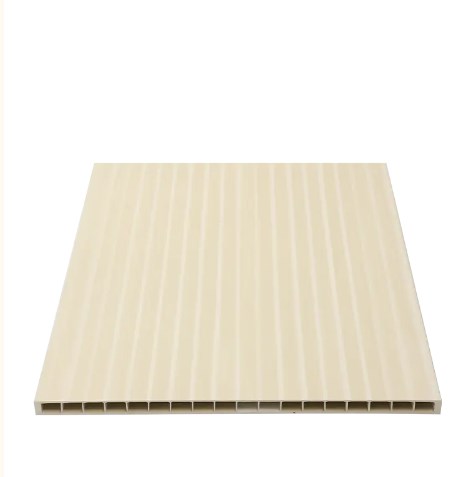
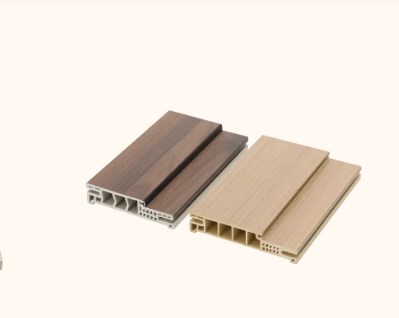
A PVC window sill board is an extruded UPVC profile that caps the interior ledge of a window opening, replacing the timber or MDF board a joiner would otherwise fit. It gets specified for one reason ahead of all others: water.
Condensation running down cold glass, driven rain against a badly flashed reveal, and the daily wipe-down of a kitchen or bathroom ledge are the three conditions that ruin a timber sill inside two heating seasons. A swollen board lifts the plaster return, splits the paint line, and traps moisture against the reveal where mould then establishes itself.
On a multi-storey building that failure repeats at every wet-side window, and every replacement means cutting back the finish, removing the board, treating the substrate and rebuilding the reveal. Buyers who ask for a pvc window sill board quote are usually trying to stop that cycle before the first winter, not after the third.
The real decision points are wall thickness, profile width and the substrate the board is bedded onto. Colour is the last item on the list.
A PVC window sill board is a rigid, extrusion-formed profile made from unplasticized polyvinyl chloride, normally supplied in widths from 100 mm to 300 mm with a wall thickness between 1.5 mm and 3.0 mm. It is cut to length on site, bedded onto the reveal with a neutral-cure adhesive or fixed through its upstand, and finished with an end cap, a return, or a scribed joint to the plaster.
The thermal coefficient of UPVC sits at roughly 0.06 to 0.08 mm per metre per Kelvin, so a 2.4 m board swings by a little over a millimetre between a cold winter delivery and a warm room. That movement is small but real, which is why the ends of a long run should never be locked tight against both jambs.
UPVC absorbs roughly thirty to forty times less water than MDF by weight, and that single figure explains almost every failure and every repair seen on the wet side of a building.
| Material | 24 h water absorption | Swelling under moisture | Service life, wet interior | Upkeep |
| UPVC window sill board | Under 0.5 % | Negligible | 20 to 30 years | None |
| Softwood, pine or spruce | 12 to 15 % | Visible, grain lifting | 5 to 10 years | Repaint every 3 to 5 years |
| MDF | 15 to 18 % | Severe, swollen edges | 3 to 6 years | Repaint every 3 to 5 years |
| Aluminium profile | 0 % | None | 25 years and above | None, higher unit cost |
Weight-percent absorption is only the raw number, and the consequence behind it matters more. A wood-based board that takes on three percent moisture changes dimension, and dimension change is what cracks the paint film. Once the film cracks, the next wet cycle starts further inside the board.
On a residential project this is not a cosmetic argument. A swollen sill lifts the plaster return, opens the joint at the jamb and gives condensation somewhere to sit. The failure pattern repeats so consistently that it is documented in this comparison of UPVC window sill boards against timber.
Over a 25-year cycle, a pvc window sill board costs roughly one fifth of a solid oak sill, and most of that gap comes from labour rather than material.
Estimated 25-year cost of ownership per linear metre, USD
Includes material, fixing, repaint cycles and replacement labour on a typical residential window reveal.
The gap is created by repaint cycles. A timber sill needs recoating every three to five years, and each recoating cycle means sanding, priming and two finish coats on a horizontal surface that collects dust and knocks. A pvc window sill board needs a wipe with a damp cloth and nothing else.
Multiply that across two hundred windows and the difference stops being a unit-price discussion. The repaint and replacement intervals become a recurring maintenance line that follows the building for its whole life, and horizontal ledges are always the first surfaces to fail.
Lock four numbers before you release a purchase order: wall thickness, water absorption, dimensional stability under heat, and UV stabilisation. Everything else is negotiable.
Two of these items cause most of the trouble in practice. Boards that measure under 1.5 mm wall thickness are easy to cut but flex under load, and boards sold without a UV layer are the ones that go chalky and pale within three summers on a bright elevation.
Nearly every failed pvc window sill board fails at the substrate rather than inside the profile, so the sequence below matters more than the material grade.
Protect the finished face during the rest of the fit-out. Plaster, tile adhesive and paint splashes are far easier to remove while the film is still on, and a sill that gets scratched during snagging is a sill that gets rejected at handover.
Custom cutting is the cheapest way to remove both site waste and visible mid-run joints, and the saving is usually larger than the price difference between suppliers.
Standard extrusions ship in 3 m or 6 m lengths. If a cut list runs 2.4 m, 1.8 m and 1.15 m, a single 6 m length yields two usable pieces and leaves 0.65 m on the floor, and the short piece still has to be jointed on site where everyone can see it. A supplier cutting to the schedule delivers lengths that drop straight in with no joint and no offcut to dispose of.
Send the opening schedule and the cut list together so the factory can nest the lengths across the full order. That is also the moment to confirm delivery format, bundle labels and whether the boards arrive with the protective film intact.
For projects with non-standard opening sizes, colours or integrated end returns, the fastest route is to request a quotation with drawings attached rather than ordering from stock lengths and adapting on site.
A properly stabilised UPVC sill board holds its colour and dimensions for 20 to 30 years indoors. On a south or west facing window with high daylight exposure, specify a co-extruded UV layer and a light colour; unstabilised boards begin to chalk and fade within three to five years.
Yes, provided the substrate is flat within 2 mm over a 2 m straightedge and the new board does not foul the window opening. Bond with a neutral-cure adhesive over the full bearing area, and use a wider profile so the old sill edge stays hidden.
The material costs roughly 20 to 40 percent more per metre than softwood. Across a 25-year cycle it works out cheaper, because timber needs recoating every three to five years and typically needs replacing once within that period, while the UPVC board needs neither.
Yes. Leave 2 to 3 mm at each end on a 2.4 m board. UPVC expands and contracts with temperature, and a board installed tight against both jambs will eventually bow or crack the joint to the plaster.

 English

 English
 عربى
عربى Español