Suppose you are pricing a batch of PVC panels for a washroom partition project. The supplier tells you the board is 8 mm foamed PVC with a density of 0.6 g/cm3. Your next question is practical: can one person carry this? What will it add to the freight bill? The short answer is that PVC panel weight is a direct calculation from two numbers — density and thickness. Foamed PVC usually lands between 0.5 and 0.9 g/cm3, while solid PVC sits near 1.4 g/cm3. A standard 4 × 8 ft sheet at 3 mm can weigh from about 10 lb to roughly 28 lb depending on formulation, while a 12 mm solid board can pass 100 lb. This guide explains how to estimate panel weight in under a minute, why it varies between suppliers, and what those numbers mean for your project.

Three factors control the final weight: the density of the material, the thickness of the panel, and the internal structure created during manufacturing. The easiest way to see the effect is to compare panels of the same size. An 8 mm foamed panel at 0.7 g/cm3 weighs 5.6 kg/m2. An 8 mm solid panel at 1.4 g/cm3 weighs 11.2 kg/m2. Same dimensions, twice the weight, and generally more stiffness and impact resistance as a result.
Most panels sold for ceilings, partitions, wall cladding, and interior fit-out work are foamed PVC. The extrusion process leaves a cellular core, which keeps the sheet light while preserving enough strength for indoor use. Solid PVC sheet is a different product family: heavier, harder, and usually specified where the board will take physical abuse or support a load.
Additives such as color pigments, fillers, and UV stabilizers shift the density slightly, but in practice the effect on total weight is small — usually well under 5 percent. Moisture absorption is negligible for unplasticised PVC, so storage conditions and humidity should not be treated as a serious source of weight change.
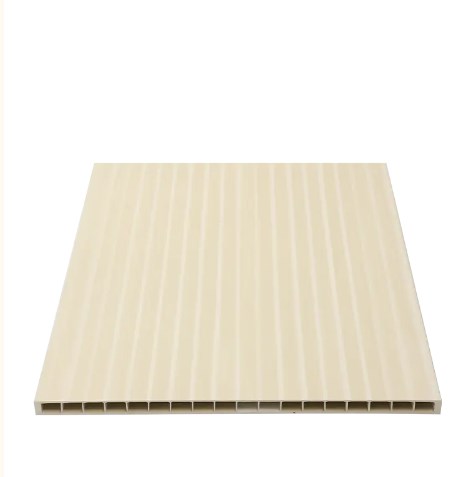
For a partition project, the weight difference between a low-density and a high-density panel is often the difference between a screw that holds and one that strips. If you are comparing formats for a room divider or an interior partition, you can look through the available thicknesses in our UPVC partition board range and see how the stated format changes the practical handling weight.
Both values appear on most technical datasheets, and once you have them, the calculation is straightforward. Weight per square metre in kilograms equals thickness in millimetres multiplied by density in grams per cubic centimetre:
Weight (kg/m2) = thickness (mm) × density (g/cm3)
The units work out because 1 mm of thickness is 0.001 m and 1 g/cm3 is 1000 kg/m3. An 8 mm board at 0.7 g/cm3 is therefore 5.6 kg/m2.
To estimate a full sheet, multiply by the sheet area. A 4 × 8 ft sheet has an area of about 2.97 m2 (32 ft2), so the example above gives 16.6 kg per sheet. Change the thickness to 12 mm and the same density gives 8.4 kg/m2, or about 25 kg for that sheet.
Never rely on thickness alone. A 10 mm panel from one supplier may be a low-density foamed board at 0.5 g/cm3 (5 kg/m2), while another supplier's 10 mm board may be solid PVC at 1.4 g/cm3 (14 kg/m2). That is nearly a three-fold difference, and the price, cutting behaviour, and suitable application are different as well.
The tables below cover the density range you will meet in practice. Table 1 gives weight per square metre. Table 2 converts those values to pounds for the common 4 × 8 ft sheet. To use them, find the thickness in the left column and follow that row to the column closest to your density. If the supplier quotes a density such as 0.6 g/cm3, take the average of the 0.5 and 0.7 columns; the result is close enough for budgeting and transport planning.
| Thickness (mm) | Foamed PVC (0.5 g/cm3) | Foamed PVC (0.7 g/cm3) | Foamed PVC (0.9 g/cm3) | Solid PVC (1.4 g/cm3) |
|---|---|---|---|---|
| 3 | 1.5 | 2.1 | 2.7 | 4.2 |
| 5 | 2.5 | 3.5 | 4.5 | 7.0 |
| 8 | 4.0 | 5.6 | 7.2 | 11.2 |
| 10 | 5.0 | 7.0 | 9.0 | 14.0 |
| 12 | 6.0 | 8.4 | 10.8 | 16.8 |
| Thickness (mm) | Foamed PVC (0.5 g/cm3) | Foamed PVC (0.7 g/cm3) | Foamed PVC (0.9 g/cm3) | Solid PVC (1.4 g/cm3) |
|---|---|---|---|---|
| 3 | 10 | 14 | 18 | 28 |
| 5 | 16 | 23 | 30 | 46 |
| 8 | 26 | 37 | 47 | 73 |
| 10 | 33 | 46 | 59 | 92 |
| 12 | 39 | 55 | 71 | 110 |
Weight is not just a number on a datasheet. It changes how you order, transport, store, and install the material.
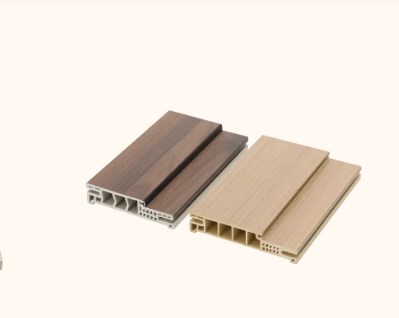
Some areas of a building make the trade-off very visible. A window sill, for instance, has to resist permanent load, moisture, and occasional impact without sagging. This is why we design our UPVC windowsill board with the right balance of body weight and wall stiffness; the panel weight is a specification our customers check before they calculate the joint compound and edging work.
Do not pick a panel purely because it is light, or purely because it is heavy. The right weight follows from the application. Foamed PVC is the default for wall cladding, ceiling panels, skirting boards, and door surfaces, because it is easy to cut, cheap to move, and light on the supporting structure. Solid PVC is preferred for industrial sheet, machine guards, welding screens, and parts that must resist impact and repeated handling.
The practical ranges we share with customers are simple:
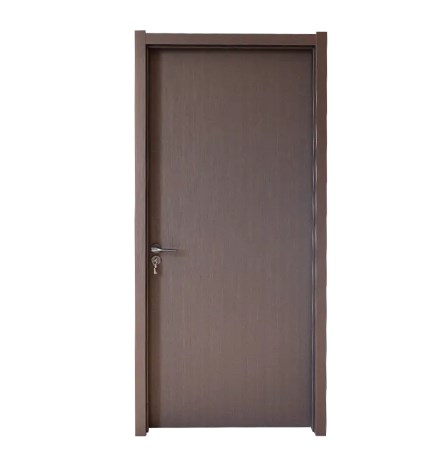
Door panels are a good example of this balance. A door needs to be light enough for standard hinges and day-to-day use, but dense enough to feel stable and hold screws. Our WPC door panel uses a foamed composite core with a compacted surface layer, which keeps the overall panel weight practical while preserving rigidity and a clean finish.
Ordering by thickness alone is the quickest way to end up with the wrong panel. Request three numbers from the supplier: nominal density, thickness tolerance, and weight per square metre. For large projects, also ask for the weight per full sheet and check whether the figure includes a protective film.
Wondering why this matters on a real purchase? Two panels with the same thickness can behave differently. At 8 mm, a 0.5 g/cm3 foamed board weighs 4 kg/m2, while a 0.9 g/cm3 board weighs 7.2 kg/m2. Both can be labelled "8 mm PVC sheet", but one suits a lightweight wall cladding and the other gives a noticeably more rigid surface. Confirm the actual density and make the supplier state it in the quotation.
Also confirm the operating conditions. Weight is only part of the decision; UV resistance, fire rating, and impact strength matter too. For a broader view of where each PVC panel type makes sense, our earlier article on PVC panel applications covers the main uses. If a specific project needs a verified weight figure, send the dimensions and the intended installation to our technical team, and we will provide the corresponding density, thickness, and sheet weight.
The calculation behind a PVC panel weight is simple once you know the material. Read the density and thickness, multiply them for the weight per square metre, and multiply again by the sheet area for the total weight. That sequence gives you a stable basis for comparing suppliers, planning transport, and avoiding an installation surprise. Gwing has worked with PVC and WPC boards for more than two decades, and we are used to customers asking for exact weight data before placing an order. Start with the numbers, not with the marketing terms, and the estimate will take care of itself.

 English

 English
 عربى
عربى Español