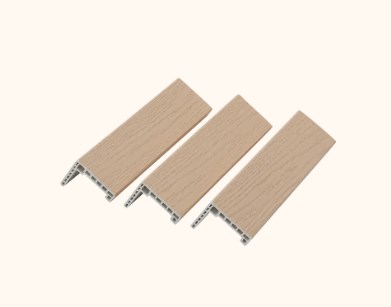
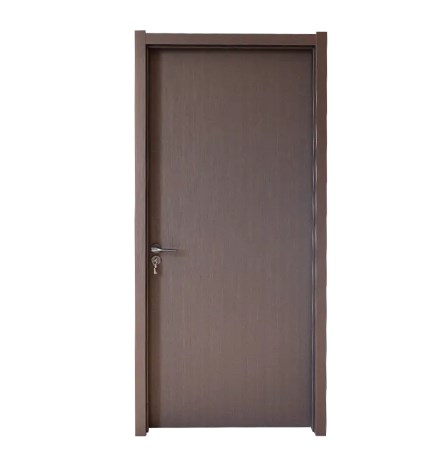
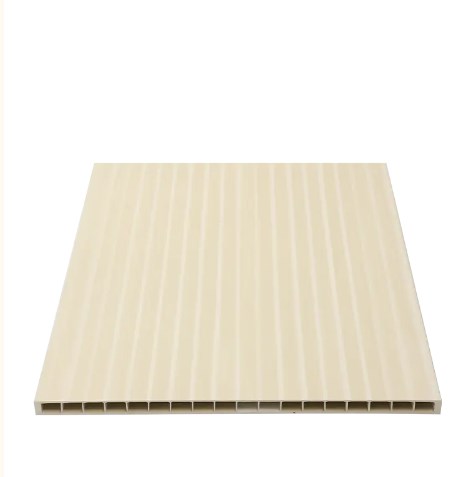
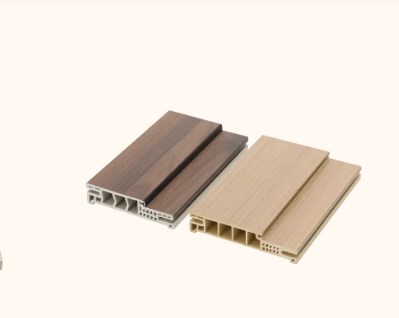
WPC skirting is increasingly used as an alternative to traditional wood and MDF baseboards in homes, apartments, hotels, offices, and other interior projects. It combines the decorative role of conventional skirting with the moisture resistance and dimensional stability expected from modern polymer composite materials.
For homeowners, the main questions are usually about appearance, waterproofing, installation, and cost. Contractors and distributors, however, also need to consider profile dimensions, accessories, packaging, customization, test documentation, and order quantities.
This guide explains what WPC skirting is, how to select the right profile, where it performs best, how it is installed, and how it compares with PVC, MDF, solid wood, and aluminum alternatives.
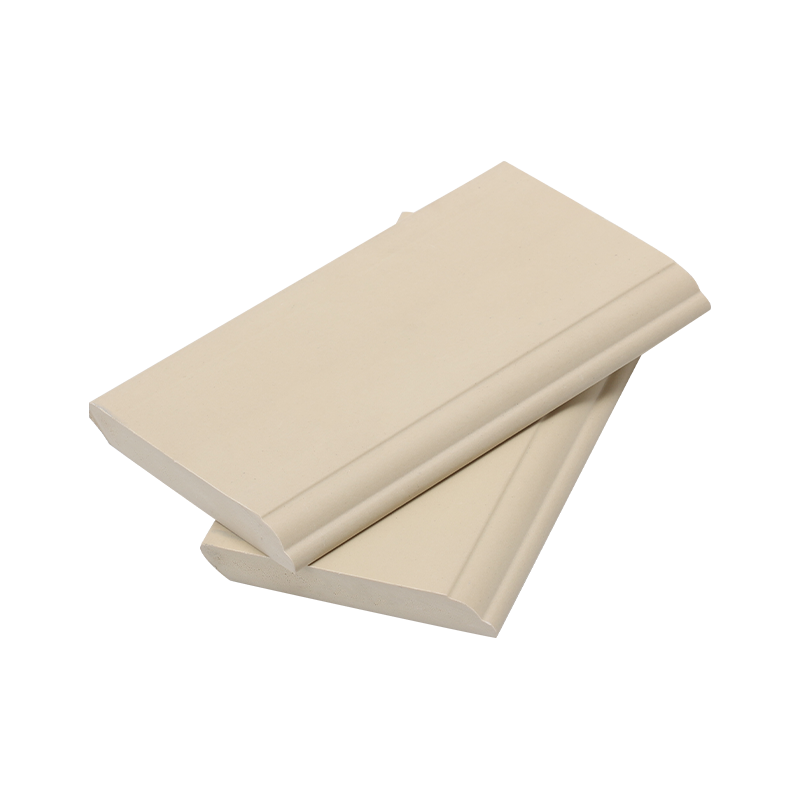
WPC skirting, also called WPC skirting board or WPC baseboard, is an interior trim profile installed along the bottom edge of a wall.
It performs three main functions:
WPC stands for wood-plastic composite. Depending on the formulation, the material generally combines polymer resin, wood-based filler or fiber, and functional additives. The mixture is processed through extrusion equipment to form a continuous profile.
After extrusion and cooling, the profile may receive a decorative surface such as solid color, wood grain, marble or stone-look film, depending on the intended interior style.
JiangYin Gwing Technology Co. Ltd specializes in PVC and WPC polymer composite products and operates extrusion, vacuum cooling, shaping, cutting, and surface-lamination processes in its own manufacturing facility. The company states that its factory has 32 automatic extrusion lines for PVC, WPC, and related materials.
The shape and height of a skirting board can noticeably change how a room looks.
Common profile styles include:
In the U.S. baseboard market, 3-1/4, 4-1/4, and 5-1/4 inches are among the most common heights. Lower profiles generally suit rooms with 8-foot ceilings, while wider profiles can look more proportional in rooms with higher ceilings.
For international WPC purchasing, dimensions are also frequently specified in millimeters. Buyers should therefore confirm profile height, thickness, length, cross-sectional shape, and installation system rather than comparing products by height alone.
Finish selection should coordinate with both flooring and wall color. Light oak or warm wood-grain skirting works naturally with beige walls and wood-look flooring, while white, gray, or black profiles fit many modern interiors. Stone-look surfaces can work with tile or marble-look flooring.
For easier installation, also check whether the supplier offers matching end caps, connectors, internal corners, external corners, and mounting clips. A complete accessory system can reduce the amount of miter cutting required on site.
Moisture resistance is one of the main reasons buyers consider WPC instead of conventional MDF or untreated wood.
Because WPC contains polymer material, it generally has better resistance to moisture-related swelling and decay than standard fiberboard. That makes it particularly useful in areas such as:
However, moisture-resistant material should not be confused with a completely waterproof wall system.
Water can still enter through joints, damaged sealant, gaps behind the skirting, or the wall substrate itself. In bathrooms or other wet areas, appropriate joint sealing and substrate waterproofing remain important.
Long-term performance also depends on formulation and surface finish. Buyers should evaluate resistance to scratches, stains, cleaning chemicals, UV exposure, and dimensional changes instead of assuming every WPC product performs identically.
For areas receiving direct sunlight, such as spaces beside large windows, ask whether the selected decorative film or surface treatment has been evaluated for color stability.
Routine maintenance is simple in most indoor applications: remove dust and clean the surface with a damp cloth and mild cleaner. Abrasive pads and aggressive solvents should generally be avoided unless approved by the manufacturer.
For commercial buildings, hotels, apartments, schools, or other specification-driven projects, appearance is only part of the purchasing decision. Buyers may also require technical documentation.
Depending on the market and project, relevant documentation may include:
In the United States, ASTM E84 may be requested for certain building products. ASTM describes E84 as a test method for comparing surface flame spread and smoke development under controlled fire exposure. Importantly, ASTM also notes that a flame-spread result alone does not define a material as noncombustible.
Therefore, buyers should not assume that all WPC skirting has the same fire classification simply because it uses the same general material category.
For a regulated project, request the actual report for the specific formulation and profile being purchased and confirm that it satisfies the local building requirements.
The same principle applies to environmental claims. Ask for supporting documentation rather than relying solely on descriptions such as “green,” “recyclable,” or “eco-friendly.”
WPC skirting can often be installed using familiar woodworking tools, although the exact method depends on the profile.
Typical tools include:
Measure the wall perimeter and subtract large openings where skirting will not be installed. Add approximately 5–10% extra material for cuts, corners, and possible mistakes.
Determine where full lengths can be used before cutting. Long visible walls should ideally have fewer joints.
Internal and external corners can be finished with miter cuts or compatible corner accessories, depending on the product system.
Use a fine-tooth blade for a cleaner edge. Test-fit each section before applying adhesive or completing mechanical fixation.
Wear eye and respiratory protection during cutting because composite machining can generate fine dust.
Installation methods may include mounting clips, construction adhesive, or a combination of mechanical and adhesive fixation.
The correct method depends on the substrate:
Always verify adhesive compatibility with both the WPC surface and wall substrate.
Do not automatically apply floating-floor expansion-gap rules to WPC skirting. Skirting is normally attached to the wall, while flooring may need to move independently underneath it.
Required end clearance depends on profile length, installation method, temperature range, and manufacturer recommendations.
Install end caps, connectors, and corner pieces where available. Check alignment before the adhesive cures and clean away excess adhesive immediately.
Different skirting materials perform better in different environments.
| Factor | WPC | PVC | MDF | Solid Wood | Aluminum |
|---|---|---|---|---|---|
| Moisture resistance | High | Very high | Low | Medium | Very high |
| Wood-like appearance | High | Medium | High when painted | Excellent | Low |
| Painting required | Usually no | Usually no | Usually yes | Often painted or stained | No |
| Dimensional stability | High | High | Moderate | Moderate | Very high |
| Maintenance | Low | Low | Moderate | Moderate | Low |
| DIY cutting | Relatively easy | Easy | Easy | Easy | More specialized |
| Best use | Humid interiors, residential and commercial projects | Wet or utility areas | Dry budget interiors | Premium traditional interiors | Modern/commercial interiors |
MDF remains attractive for dry rooms where low initial material cost and painted finishes are priorities.
Solid wood provides an authentic natural appearance and can often be repaired or refinished, but humidity changes require more attention.
PVC is highly moisture resistant but may not provide the same wood-like visual character as some WPC finishes.
Aluminum is durable and well suited to minimalist commercial interiors, although cutting and corner treatment can require specialized tools.
WPC is therefore particularly useful when a project needs a balance of decorative appearance, moisture resistance, low maintenance, and relatively straightforward installation.
Skirting quantity is usually calculated by linear length rather than floor area.
A simple calculation is:
Required skirting = room perimeter − openings + cutting allowance
For example, consider a 12 × 15 ft room:
For multi-room projects, calculate each room separately before combining the total. This helps avoid underestimating corners and waste.
The cost of WPC skirting varies too widely to assign one universal price per linear foot. Important pricing factors include:
For factory orders, pricing may be quoted per piece or meter rather than according to U.S. retail pricing conventions.
Start with the installation environment.
For a modern apartment, a flat low-profile skirting in white, gray, or matching wood grain usually creates a clean appearance. Taller decorative profiles can better suit traditional residential interiors or rooms with higher ceilings.
For kitchens, basements, rental apartments, hotels, and other areas where cleaning and humidity are important, prioritize moisture resistance and an easy-clean surface.
Commercial buyers should also examine factors that individual homeowners may overlook:
Ordering samples before a large purchase is especially useful when matching skirting with flooring, doors, or wall panels because screen colors rarely reproduce decorative films accurately.
For distributors, contractors, developers, and building-material brands, purchasing directly from a manufacturer provides additional options beyond standard retail profiles.
Before requesting a quotation, prepare:
JiangYin Gwing Technology Co. Ltd, founded in Jiangyin, Jiangsu Province, produces WPC skirting as part of its WPC material series and supports customized polymer composite products. For standard products, buyers can provide the required quantity for quotation; for non-standard products, the company recommends supplying drawings and detailed requirements. Its published standard delivery period is approximately 15–20 days, while MOQ varies by product.
Comparing two or three physical samples before confirming a large order is a practical way to evaluate color, surface texture, profile proportions, rigidity, cutting quality, and compatibility with the planned interior design.
Consider ceiling height, wall color, flooring, and interior style together. Flat profiles suit modern interiors, while rounded or decorative profiles work well in more traditional spaces. Obtain physical finish samples whenever color matching is important.
U.S. baseboards commonly use heights such as 3-1/4, 4-1/4, and 5-1/4 inches. However, imported and customized WPC profiles may use metric dimensions, so confirm the exact cross-section rather than relying only on nominal height.
It can be a suitable choice because WPC generally resists moisture better than untreated wood or standard MDF. However, the skirting itself does not make the complete wall-floor joint waterproof. Proper substrate waterproofing and joint sealing are still important in wet areas.
Typical tools include a tape measure, miter saw with a fine-tooth blade, square, level, drill, caulking gun, and safety equipment. Depending on the profile, installation may use clips, adhesive, mechanical fasteners, or a combination.
The answer depends on profile, finish, size, order quantity, and market. WPC may have a higher initial material cost than basic MDF but can offer advantages where moisture resistance and reduced repainting or replacement are important.
Regular dusting and occasional cleaning with a damp cloth and mild cleaner are generally sufficient. Avoid abrasive cleaning pads or strong solvents unless the manufacturer confirms that the surface finish can tolerate them.
Recyclability depends on the exact WPC formulation and local recycling infrastructure. Commercial buyers should request supporting environmental documentation and, when required by the project, applicable fire, emission, or material test reports rather than assuming that all WPC products carry the same certifications.

 English

 English
 عربى
عربى Español