UPVC cable tray is a non-metallic cable management system made from unplasticized polyvinyl chloride, engineered to resist corrosion, moisture, and chemical attack in environments where steel and even fiberglass reinforced plastic (FRP) systems fall short on cost or maintenance. This guide covers material properties, application limits, standard sizing, load data, installation practices, and a direct cost and performance comparison against steel and FRP trays, so engineers and procurement teams in chemical, wastewater, coastal, and industrial facilities can select the right system with confidence.
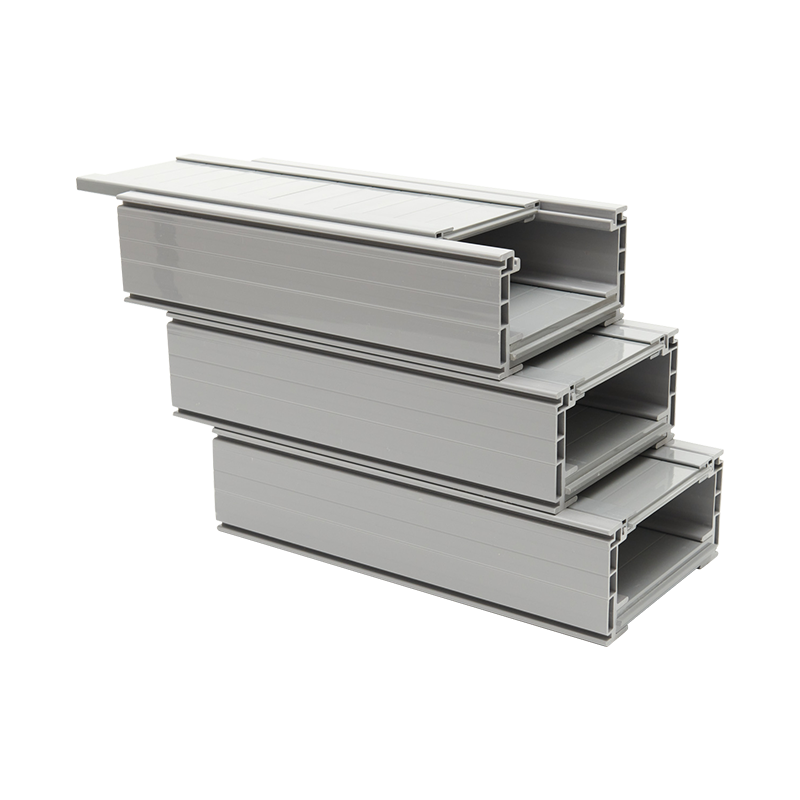
UPVC (unplasticized polyvinyl chloride) cable tray is a rigid, non-conductive cable support system built from PVC resin compounded with reinforcing fillers, UV stabilizers, and flame retardants. Unlike standard flexible PVC used in pipe fittings or cable jacketing, UPVC contains no plasticizers, which gives it higher rigidity, better dimensional stability, and greater resistance to softening under load or heat.
The core advantage of UPVC over metallic tray systems is chemical inertness. Metal trays, including galvanized steel, depend on a zinc or paint coating to resist corrosion. Once that coating is scratched during installation or degraded by acid fumes, salt spray, or standing moisture, base metal corrosion begins and accelerates. UPVC has no coating to fail: the material itself resists attack from most dilute acids, alkalis, salts, and industrial solvents, which is why it performs reliably in electroplating shops, wastewater treatment basins, and coastal substations where galvanized trays typically need replacement within five to eight years.
UPVC cable tray is also fully non-conductive, with high insulation resistance and a low dielectric constant, which removes the risk of stray current paths or electric shock through the tray structure itself. This matters in hospitals, electronics plants, and any facility where bonding and grounding of a metal tray network adds cost and inspection burden.
| Property | UPVC Cable Tray Behavior |
| Corrosion resistance | Resists acids, alkalis, salt spray, and most industrial solvents without coating degradation |
| Conductivity | Non-conductive, high dielectric strength, no bonding or grounding required for the tray itself |
| Weight | Roughly one-third the weight of an equivalent steel tray, reducing support spacing and labor |
| Fire behavior | Self-extinguishing formulation with flame retardant additives, low smoke and low toxicity compared to unmodified PVC |
| Maintenance | No repainting or re-galvanizing cycle required over the service life of the tray |
A properly compounded UPVC tray also carries a self-extinguishing, low-smoke rating, meaning that in a fire scenario it does not actively propagate flame along the cable route the way unmodified PVC or certain plastics can. This flame retardant behavior is a direct extension of the material chemistry and is a factor procurement teams should confirm against project fire code requirements before specification.
UPVC cable tray is best suited to environments where corrosion, not extreme mechanical load or heat, is the primary design driver. Typical applications include wastewater and water treatment plants, chemical processing and electroplating workshops, pulp and paper facilities, food and beverage plants with acid washdown areas, and coastal or offshore-adjacent installations along the Gulf Coast, Atlantic seaboard, and Pacific Northwest where salt fog accelerates metal corrosion. It is also used in subway and tunnel systems, mines, communication base stations, and data centers where insulation performance and lightweight installation are priorities.
Outdoor use requires two checks before specification. First, UV exposure: UPVC compounded with UV stabilizers holds up well under sustained sunlight, but unstabilized or generic PVC can chalk and become brittle over years of direct exposure, so confirming the UV package with the supplier matters for installations in high-UV regions such as Arizona or the Desert Southwest. Second, temperature: UPVC cable tray is typically rated for continuous service up to approximately 60°C (140°F), and its mechanical strength and load capacity decrease as ambient temperature rises. In a Florida rooftop or an unshaded industrial yard where surface temperatures can exceed this threshold, a project should verify de-rated load values with the manufacturer rather than apply nameplate figures directly.
UPVC is not the right choice for every project. It is not recommended for sustained high-temperature service above its rated threshold, for locations demanding very high mechanical strength or heavy point loads without additional support spacing, or for applications where local fire code specifically mandates a metallic raceway. Being upfront about these limits helps engineers avoid misapplication and callback issues later in a project.
UPVC cable tray is produced in two common structural forms: trough type, which is enclosed and offers the highest degree of cable protection, and ladder type, which offers better ventilation and heat dissipation for higher-density cable runs. Standard width by height combinations (in millimeters) available from Jiangyin Gwing Technology include the following.
| Tray Type | Standard Width x Height (mm) |
| Trough type | 50x50, 100x100, 150x100, 200x100, 200x150, 200x200, 300x100, 300x150, 300x200, 400x100, 400x150, 400x200, 500x100, 500x150, 500x200, 600x100, 600x150, 600x200 |
| Ladder type | 200x100, 200x150, 200x200, 300x100, 300x150, 300x200, 400x100, 400x150, 400x200, 500x100, 500x150, 500x200, 600x100, 600x150, 600x200 |
Standard lengths run 2 to 3 meters (roughly 78 to 118 inches) per section, and custom lengths and widths can be produced to match project drawings. Load capacity for a given tray depends on width, height, wall thickness, and support span, with published values from manufacturers typically covering uniformly distributed load (UDL) at support spans of 1 to 3 meters. Because UPVC load ratings de-rate with span length and ambient temperature, request span-specific load tables from the supplier rather than assuming a single figure across all spans.
Installation follows a straightforward sequence. Sections are cut to length using a standard circular saw or fine-tooth blade, and holes for cable drops or fasteners are drilled rather than punched, since UPVC does not deform the way sheet metal does under a punch. Sections join either by solvent welding, which produces a permanent, fully sealed joint suited to enclosed trough runs, or by mechanical connectors and coupling plates, which allow for thermal expansion and easier future modification, particularly on ladder type runs. Covers, brackets, tees, elbows, and reducers complete the system and should be specified from the same manufacturer to keep wall thickness and fastener spacing consistent. Support spacing, bonding requirements for adjacent metallic conduit, and fill ratios should be checked against NEC and NFPA 70 guidance for nonmetallic cable tray systems before finalizing the installation plan, since local jurisdictions may apply additional conditions for nonmetallic raceways in specific occupancy classes.
Steel, FRP, and UPVC each hold a legitimate place in cable tray specification, and the right choice depends on which project variable matters most: chemical exposure, mechanical load, fire code, or total installed cost. The table below lays out the core trade-offs.
| Criteria | UPVC | Galvanized / Stainless Steel | FRP |
| Initial material cost | Lowest to mid | Low (galvanized) to high (stainless) | Highest |
| Life-cycle cost | Low, minimal recoating or replacement | Higher, recoating or replacement in corrosive settings | Low once installed, but repairs are specialized |
| Corrosion resistance | Excellent against acids, alkalis, salts | Weak (galvanized) to good (stainless), coating dependent | Excellent, comparable to UPVC in most media |
| Weight and handling | Lightest, one-person installation on smaller sizes | Heaviest, needs lifting equipment on larger runs | Light to moderate, resin can be brittle to handle |
| Fire performance | Self-extinguishing with flame retardant additives | Non-combustible | Resin dependent, some grades meet UL 94 V-0 |
| Electrical conductivity | Non-conductive, no bonding needed for the tray | Conductive, requires bonding and grounding | Non-conductive |
| Best fit | Moderate loads, corrosive or coastal sites, budget-sensitive projects | Heavy mechanical loads, non-corrosive or code-mandated metallic settings | Severe chemical exposure combined with high mechanical demand |
As a starting framework: choose UPVC when the project sits in a corrosive or coastal environment with moderate load requirements and cost control matters; choose steel when mechanical load or code requires a metallic raceway in a non-corrosive setting; and choose FRP when chemical exposure is severe and combined with load demands that exceed typical UPVC ratings. Reviewing the corrosion profile, load schedule, fire code, and budget together, rather than any single factor in isolation, gives the clearest path to the right material.
Jiangyin Gwing Technology Co., Ltd. has manufactured UPVC and WPC composite materials for nearly 20 years, supplying trough type and ladder type UPVC cable tray in standard and custom sizes for chemical, coastal, industrial, and municipal projects worldwide. Contact our team for the latest technical datasheet, span-specific load tables, a free sample, or a quote on custom lengths and widths for your project. We provide full support from product consultation through production and shipment, with fast turnaround from our facility near Shanghai Port.
| Company | Jiangyin Gwing Technology Co., Ltd. |
| Address | No.39, Zhenyang Road, Qingyang Town, Jiangyin City, Jiangsu Province, China |
| Phone | +86-15052195508 |
| cfeng.bmt@outlook.com | |
| Website | gtwpc.com |
What is UPVC cable tray and what are its main benefits?
UPVC cable tray is a rigid, non-metallic cable support system made from unplasticized PVC compounded with flame retardants and stabilizers. Its main benefits are strong chemical corrosion resistance, non-conductivity, light weight compared to steel, and self-extinguishing fire performance.
How corrosion-resistant is UPVC compared to metal cable trays?
UPVC resists acids, alkalis, salts, and most industrial solvents without any coating to fail, while galvanized steel depends on its zinc coating and corrodes once that coating is scratched or degraded by chemical exposure.
How does UPVC cable tray compare to steel and FRP in terms of cost and performance?
UPVC generally costs less than FRP and comparable to or less than galvanized steel over the life of the installation, with corrosion resistance similar to FRP but at a lower price point, while steel remains the choice for heavier mechanical loads in non-corrosive settings.
What load capacities can I expect from standard UPVC cable trays?
Load capacity depends on tray width, height, and support span, and decreases as span length and ambient temperature increase, so request span-specific load tables from the manufacturer for your exact project conditions.
Can UPVC cable trays be used outdoors in direct sunlight and rain?
Yes, provided the UPVC compound includes UV stabilizers; confirm the UV package with the supplier for installations in high-UV regions, and verify the tray's rated continuous service temperature, typically around 60°C (140°F), against your site's peak surface temperature.
What are the typical dimensions of UPVC cable trays, and can I order custom sizes?
Standard trough and ladder type widths range from 50mm to 600mm with heights from 50mm to 200mm, and custom widths, heights, and lengths can be produced to match project drawings.
How do you cut, join, and install UPVC cable tray sections and accessories?
Sections are cut with a standard saw and drilled rather than punched, joined by solvent welding for permanent enclosed runs or mechanical connectors for runs needing thermal expansion allowance, and completed with covers, brackets, tees, and elbows from the same manufacturer.

 English

 English
 عربى
عربى Español