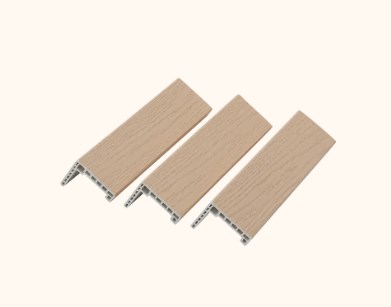
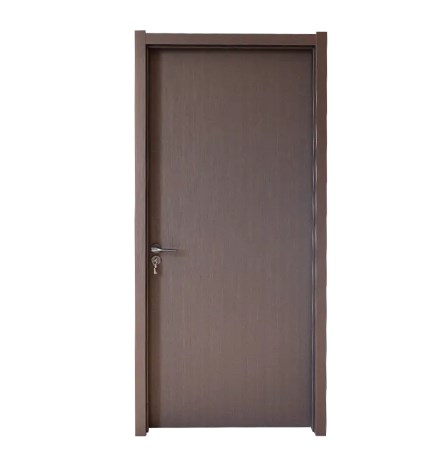
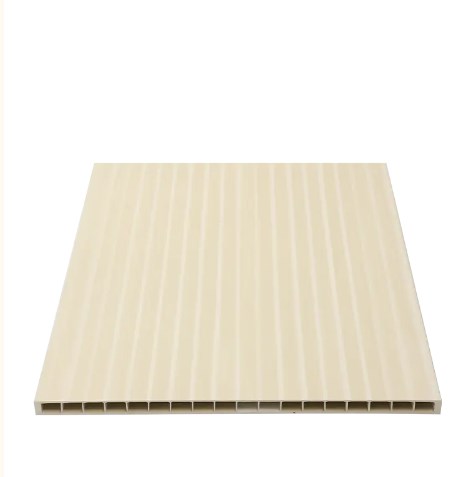
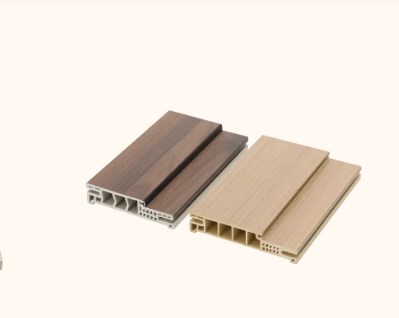
A WPC frame, short for Wood-Plastic Composite frame, is an engineered structural and decorative framing material manufactured by mixing modified thermoplastic resins (such as polyethylene, polypropylene, and polyvinyl chloride) with wood fiber powder (including wood flour, bamboo powder, rice husk powder, etc.) as the main raw materials, and then processed through high-temperature melting, extrusion, molding, and surface treatment. It is a new-generation, environmentally friendly alternative to traditional solid wood frames, aluminum alloy frames, and plastic frames, integrating the natural texture of wood and the corrosion resistance of plastic.
The core conclusion of the WPC frame application is: it has a service life of more than 15 years in conventional environments, requires almost no later maintenance, has formaldehyde-free environmental protection performance, and has comprehensive performance far exceeding traditional solid wood frames. It can stably adapt to indoor and outdoor environments with temperature and humidity changes, and is widely used in construction, home decoration, landscape engineering, and other fields, becoming the preferred framing material for green and low-carbon projects.
Unlike pure solid wood, which is prone to decay, deformation, and insect damage, and pure plastic that has poor strength and easy aging, the WPC frame perfectly balances structural stability, environmental protection, and practicality. Relevant industry test data shows that the bending strength and compressive strength of WPC frames meet national building material standards, and the weather resistance grade reaches the outdoor high-standard level, which can resist long-term sunlight, rain, and frost without obvious performance degradation.
The performance of the WPC frame is directly determined by its raw material ratio, and the production formula is scientifically matched according to different use scenarios. The raw materials are divided into three core categories, each playing an irreplaceable role in the finished product.
The production of WPC frames adopts an industrialized continuous extrusion process, which realizes automated and standardized production and ensures the consistency of product performance. The whole process is divided into five key steps: first, raw material screening and drying, removing impurities and moisture in wood fibers and plastics to prevent bubbles and cracks in the finished product; second, high-speed mixing and granulation, fully stirring all raw materials at a specific temperature to make mixed masterbatches with uniform texture; third, mold extrusion molding, sending the masterbatches into a twin-screw extruder, melting and extruding them into frame blanks of specified shapes and sizes through professional molds; fourth, stereotypes and cooling, using cooling water circulation to quickly shape the blanks and control the deformation rate within a reasonable range; fifth, surface treatment and cutting, conducting sanding, embossing, coloring and other treatments on the frame surface according to demand, and cutting them into standard sizes.
The entire production process does not produce toxic and harmful gases, waste water, or waste residues, which is in line with the green production standards of the building materials industry. The formaldehyde emission of finished WPC frames is zero, which fully meets the strict environmental protection requirements of indoor and outdoor decorative materials.
As a framing material, mechanical properties are the core indicators to measure its load-bearing capacity and service life. The WPC frame has excellent mechanical indicators after professional formula adjustment and process optimization. Its static bending strength can meet the needs of daily load-bearing frames, and the impact strength is high, not easy to break under external force collision. Compared with solid wood frames of the same specification, the WPC frame has higher dimensional stability, and the warpage deformation rate is less than 1% under long-term load-bearing conditions, while the deformation rate of solid wood frames is often more than 5% in humid and hot environments.
In addition, the nail-holding power of the WPC frame is equivalent to that of high-quality solid wood, which can firmly fix screws and connectors, ensuring the overall firmness of the frame structure. It will not appear loose or falling off due to material softening or fiber loosening, and is suitable for making load-bearing frames and decorative frames with high stability requirements.
Weather resistance is the biggest advantage of WPC frames over traditional materials. It has strong waterproof and moisture-proof properties, and will not absorb water, swell, mildew, or rot even in long-term humid, water-impact, or high-humidity environments. Relevant tests show that the 24-hour water absorption rate of WPC frames is less than 1%, far lower than the 15%-20% water absorption rate of solid wood frames, which fundamentally solves the problem of frame damage caused by moisture.
At the same time, the WPC frame is resistant to ultraviolet rays and high and low temperatures. It will not become brittle and cracked in a low-temperature environment below zero, nor will it soften and deform in a high-temperature environment above 60°C. It also has strong corrosion resistance, can resist acid, alkali, salt corrosion, and is not damaged by insects, termites, or molds. Outdoor WPC frames can maintain stable performance for more than 10 years without protective paint, greatly reducing later maintenance costs.
WPC frames are made of recycled wood fibers and waste plastics, realizing the recycling of resources and belonging to environmentally friendly recycled materials. The finished product does not contain formaldehyde, benzene, and other harmful substances, and will not release toxic gases during use, making it very safe for indoor residential, commercial, and children's activity places. In addition, the material is flame-retardant graded, and the flame retardant effect is better than that of pure solid wood, which is not easy to burn and spread flames in case of open fire, improving the safety of the frame application environment.
To more intuitively reflect the advantages of WPC frames, we compare them with three mainstream traditional framing materials (solid wood, aluminum alloy, pure plastic) in terms of performance, service life, maintenance, and cost, as shown in the table below:
| Performance Indicator | WPC Frame | Solid Wood Frame | Aluminum Alloy Frame | Pure Plastic Frame |
|---|---|---|---|---|
| Waterproof & Anti-corrosion | Excellent | Poor | Good | Good |
| Service Life | 15+ Years | 3-8 Years | 20+ Years | 5-10 Years |
| Later Maintenance | Almost None | Frequent Painting | Low Maintenance | Medium Maintenance |
| Texture & Appearance | Wood Texture | Natural Wood | Metal Texture | Single Plastic |
From the comparison data, it can be seen that the WPC frame combines the advantages of multiple materials: it has the natural texture of solid wood, the waterproof and anti-corrosion properties of plastic, and the long service life close to that of aluminum alloy. Although the aluminum alloy frame has a longer service life, its metal texture is cold and single, and the cost is higher; the solid wood frame has a good appearance but poor durability and high maintenance cost; the pure plastic frame has low strength and is easy to age. The WPC frame achieves the best balance of performance, appearance, and cost, and has higher cost performance in most application scenarios.
In the field of indoor home decoration, WPC frames are widely used in door frames, window frames, wardrobe frames, TV background wall frames, ceiling frames, etc. Relying on zero formaldehyde environmental protection performance, it is very suitable for bedrooms, children's rooms, and elderly rooms. The frame can be customized with different surface textures and colors, matching modern, simple, new Chinese, and other decoration styles. At the same time, its moisture-proof performance solves the problem of moldy and deformed frames in bathrooms, kitchens, and other humid indoor spaces, replacing solid wood frames and becoming the first choice for indoor moisture-proof framing.
Outdoor application is the core scene of WPC frames, giving full play to its weather resistance advantages. It is often used in outdoor door and window frames, garden fence frames, pavilion frames, corridor frames, outdoor advertising frame bases, etc. In outdoor landscape engineering, the WPC frame can resist wind, rain, sun, and frost all year round, without painting, anti-corrosion treatment, or regular maintenance. The application of WPC frames in outdoor projects can reduce the later maintenance cost by more than 80% compared with solid wood frames, and the service life is extended by more than twice.
In commercial places, WPC frames are used in shopping mall display stand frames, office partition frames, hotel decorative frames, etc., with an elegant appearance and durable performance. In the industrial field, it is suitable for factory moisture-proof partition frames, warehouse storage shelf frames, etc., resisting the humid and corrosive environment in the factory area. In addition, WPC frames are also used in transportation tools such as ships and RVs, relying on lightweight and waterproof properties to replace traditional metal and wood frames, reducing weight and improving service life.
For special environments such as coastal areas with high salt and humidity, underground spaces with high humidity, and agricultural greenhouses with high temperature and humidity, WPC frames have targeted customized products. By adjusting the formula and increasing the content of anti-corrosion and anti-ultraviolet additives, the frame can stably adapt to high salt, high humidity, and high temperature conditions, without corrosion, deformation, or aging, filling the application gap of traditional materials in special environments.
The installation of WPC frames is simple and flexible, and can be constructed with common woodworking tools; no professional equipment is required, and the construction efficiency is higher than that of aluminum alloy frames. The basic steps are as follows: first, measure and position, accurately measure the installation size of the frame, mark the installation position, and ensure the level and verticality; second, cut and process, cut the WPC frame into the required length with a cutting machine, and drill holes at the designated connection positions; third, fix the frame, fix the frame to the wall, ground or keel through expansion screws or self-tapping screws, and reserve a small expansion gap at the connection to adapt to thermal expansion and contraction; fourth, seal and beautify, use weather-resistant sealant to seal the gaps between the frame and the wall to prevent water infiltration, and trim the surface to keep it neat and beautiful.
One of the core advantages of WPC frames is low maintenance, and daily care is very simple, which can greatly save time and cost. For indoor WPC frames, daily cleaning only needs to wipe the surface with a soft cloth and clean water to remove dust and stains; for oil stains, use a neutral detergent to clean, avoid using strong acid and alkali cleaning agents to prevent corrosion of the frame surface. For outdoor WPC frames, regularly clean the leaves, sand, and dirt on the surface and gaps, keep the frame dry and ventilated, and no additional painting, waxing, or anti-corrosion treatment is required.
In the process of long-term use, avoid placing ultra-high-temperature items directly on the frame for a long time to prevent local thermal deformation; avoid long-term exposure to strong chemical solvents to protect the surface treatment layer. If the frame surface is slightly scratched, it can be simply polished and repaired with fine sandpaper without affecting the overall performance and appearance. Under normal use and maintenance conditions, the WPC frame can maintain good performance and appearance for more than 15 years, and the loss is far lower than that of traditional materials.
For WPC frames used in special environments, regular inspections can be carried out appropriately, such as checking the firmness of connectors and the integrity of sealants in coastal high-salt areas, and dealing with small problems in a timely manner to avoid further expansion. In general, the maintenance cost of WPC frames is less than 10% of that of solid wood frames, which is an extremely cost-effective framing material in the long run.
With the global promotion of green environmental protection, low-carbon building, and circular economy, the market demand for WPC frames is growing year by year, showing a rapid development trend. As a recycled environmental protection material, WPC frames conform to the national industrial policies and are gradually replacing solid wood, plastic, and other traditional materials in the global building materials and decorative materials market. In terms of technological development, the production formula of WPC frames is constantly optimized, and the mechanical properties, weather resistance, and appearance diversity are further improved; the production process is more intelligent and automated, reducing production costs and improving product accuracy.
In terms of application expansion, WPC frames are gradually penetrating into more fields, such as prefabricated buildings, smart home frames, outdoor sports facilities, etc., and the application scenarios are becoming more and more abundant. Relevant market research data shows that the global demand for WPC composite materials, including frames, has maintained a double-digit growth rate for many years, and the future market space is broad. WPC frames will become one of the mainstream framing materials in the global construction and decoration industry in the next decade, and their market share will continue to increase.
In addition, the lightweight, high-strength, and customizable characteristics of WPC frames match the development needs of modern construction and decoration, and can meet the personalized and diversified design needs of designers. With the improvement of consumers' requirements for environmental protection, durability, and cost performance of decorative materials, WPC frames will be more recognized and favored by the market, and become the preferred solution for framing materials in various projects.

 English

 English
 عربى
عربى Español