A 2019 bathroom renovation in a Birmingham flat looked flawless at handover. Eighteen months later, the MDF skirting behind the basin had swollen to twice its original thickness, the paint was cracking, and the baseboard had started to separate from the wall. The failing component was not the tiles, the grout, or the silicone, it was the one product nobody had questioned: the skirting. Moisture resistant skirting board selection determines whether a tiled bathroom stays crisp for decades or develops swollen, stained baseboards within two seasons. This guide compares the materials that actually survive wet areas, sets out the numbers to verify before you buy, and explains the installation details that keep moisture out.
Skirting boards in wet areas fail from moisture long before they fail from physical wear. A baseboard in a bathroom or utility room is exposed to three distinct water sources: direct splash from showers and basins, condensation that runs down the wall, and floor washing water that sits at the bottom edge. All three bypass a painted face when they enter through the back of the board or through the joint at the floor.
Standard MDF is a porous wood-fiber board, and that structure is the problem. When it sits close to a shower or basin, it pulls water in like a sponge. The typical failure sequence appears within 12 to 24 months: the bottom edge swells, the board lifts off the wall, the paint film cracks, and the core turns soft. Moisture-resistant MDF, commonly abbreviated as MR-MDF, was developed to slow this process with a water-resistant resin, but it remains a wood product with an absorption limit.
Two moisture paths are easily overlooked: condensation running down the wall behind the board, and water wicking upward from the floor through the plaster. Both reach the back of the skirting without touching the painted front, which is why a surface coating alone never solves the problem.
Four materials dominate the moisture resistant skirting market: standard MDF, MR-MDF, PVC/UPVC, and WPC, and they differ mainly in water absorption and dimensional stability. The table below summarizes the performance a specifier or contractor should expect from each.
| Material | Water absorption | Stability in wet zones | Installation | Finish options | Service life |
| Standard MDF | Absorbs water readily | Poor; edges swell and lift | Easy; every cut needs sealing | Paint-ready | 2-4 years |
| MR-MDF | Moderate absorption | Moderate; sealed edges required | Easy; prime all cut edges | Paint-ready | 5-8 years |
| PVC/UPVC | Near zero | Excellent; no swelling | Easy; requires adhesive | Limited color range | 10+ years |
| WPC | Very low, under 2% | Excellent; no edge sealing needed | Easy; standard wood tools | Paint-ready or prefinished | 10-15 years |
Typical water absorption after 24 hours, percent by weight
Read test conditions before comparing numbers. A water absorption figure is only meaningful when the soak time, sample thickness, and edge condition are stated. The values above reflect edge-sealed samples; unsealed MDF performs worse.
Rule of thumb: specify WPC or PVC in spaces with a shower, a bath, or a floor drain. In a merely humid room such as a hallway or guest WC, MR-MDF can still work.
WPC skirting boards are the most balanced moisture resistant skirting option for bathrooms, kitchens, and utility rooms because the entire profile is a closed polymer-wood matrix.
Wood-plastic composite blends wood fiber with a thermoplastic polymer binder and processing additives, then extrudes the mix into a dense board. A typical formulation contains 55-70% wood fiber, 25-40% polymer, and a small fraction of stabilizers. Because the polymer coats every wood particle, water cannot travel through the board. Manufacturers such as Jiangyin Gwing Technology Co., Ltd., which has produced WPC profiles since 2005, add a sealed skin during extrusion so the surface is as resistant as the core.
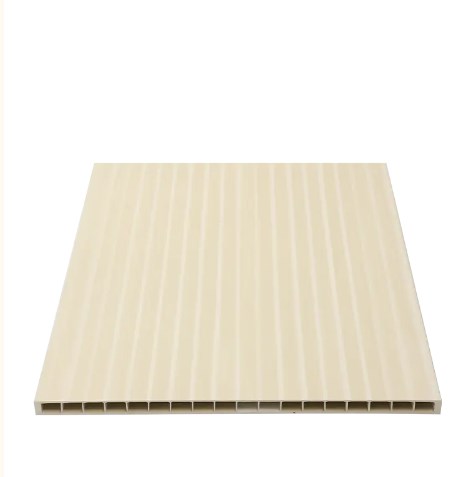
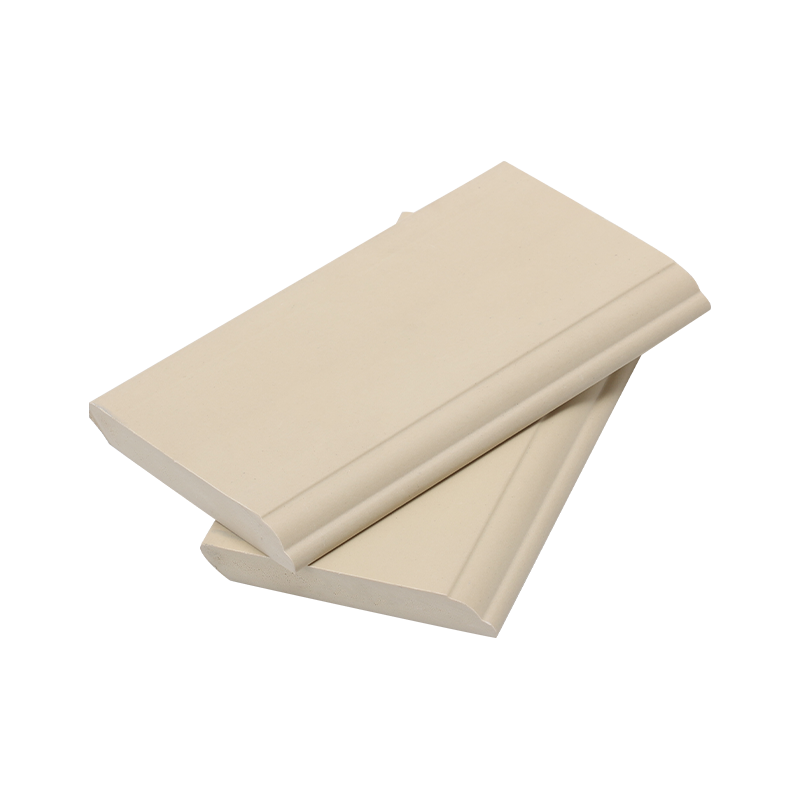 WPC Skirting Board with Moisture-Resistant Sealed SkinThis WPC skirting profile combines wood fiber and thermoplastics into a dense, waterproof board with a sealed surface, making it suitable for humid areas like bathrooms and kitchens.View Product →
The difference shows up immediately after cutting. MR-MDF cut edges expose raw fiber that pulls in moisture, so every field cut must be primed and sealed. WPC edges are inert: you cut the profile, wipe off the dust, and install it. For a journeyman working on a full bathroom, that saves hours and removes a common warranty failure.
MR-MDF skirting is cheaper in the price list, but in a shower room the comparison reverses. A set of MR-MDF boards that fails in five years costs more after replacement labor than a WPC installation that lasts fifteen. This is the core argument for specifying WPC-based moisture resistant skirting boards in wet zones.
Before buying, verify four specifications: density, water absorption, edge behavior after cutting, and finish system.
Manufacturing consistency matters as much as the specification sheet. Poor compounding creates soft spots that absorb water, which is why it pays to buy from a production facility with in-house compounding and continuous extrusion control. A manufacturer with a dedicated production line can hold profile density stable across long runs and document test results for each batch.
Ask the supplier for three documents before ordering: a density test report, a water absorption report, and a finish sample with a written water-resistance claim.
Custom sizes are the second detail that gets skipped. When wall thicknesses or room heights do not match standard stock lengths, custom-milled profiles remove the field joints that often become leak points.
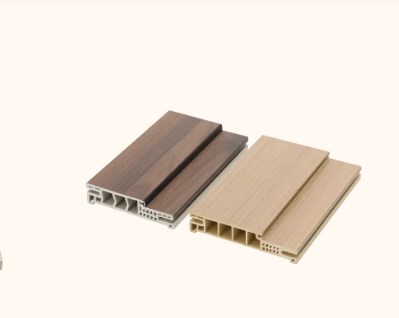
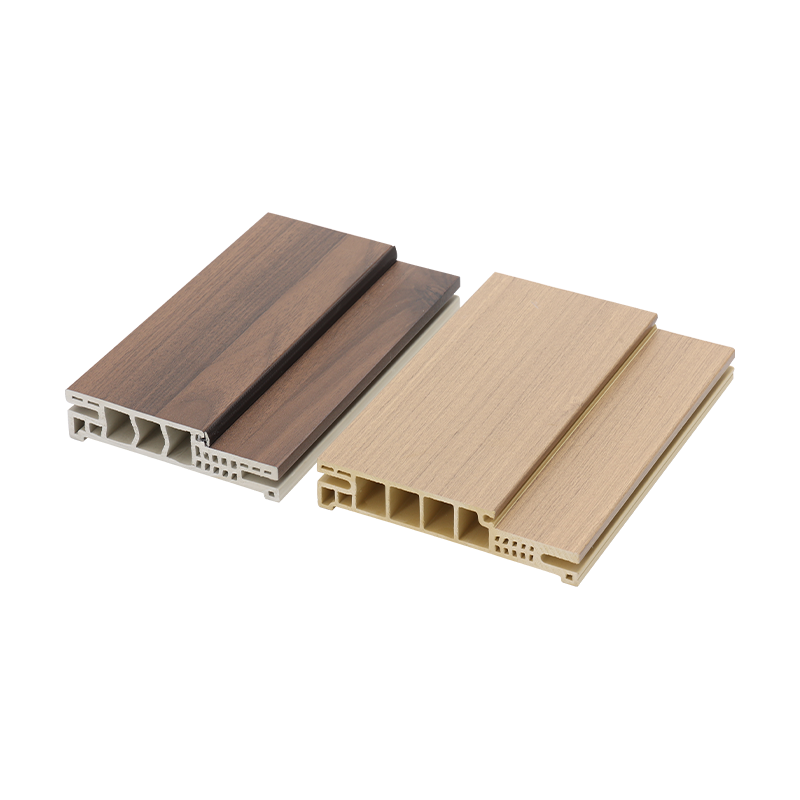 Custom-Sized WPC Skirting Profiles for Wet RoomsCustom-milled skirting sizes eliminate field joints that often become leak points in moisture-prone rooms, offering a tailored fit for non-standard wall thicknesses and heights.View Product →
Even a waterproof skirting board fails if water enters from the side or behind. Installation quality decides the real-life performance of any moisture resistant skirting board, and the six steps below reflect the method used by installers who guarantee wet-room trim work.
Adhesives matter as well: use a flexible construction adhesive, since rigid cements can crack with movement and let water into the joint line.
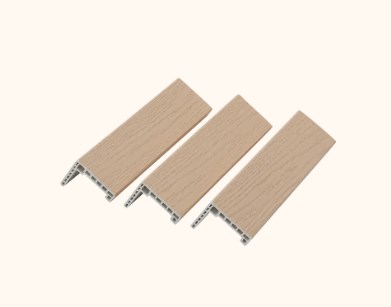
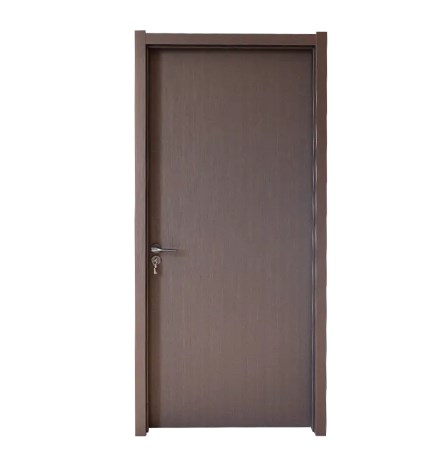
For a matched detail, pair the moisture resistant skirting with a WPC door architrave so the entire opening has the same water resistance. Door jambs and architraves in a wet room suffer the same splash and condensation as baseboards, and mixed materials create a maintenance hot spot.
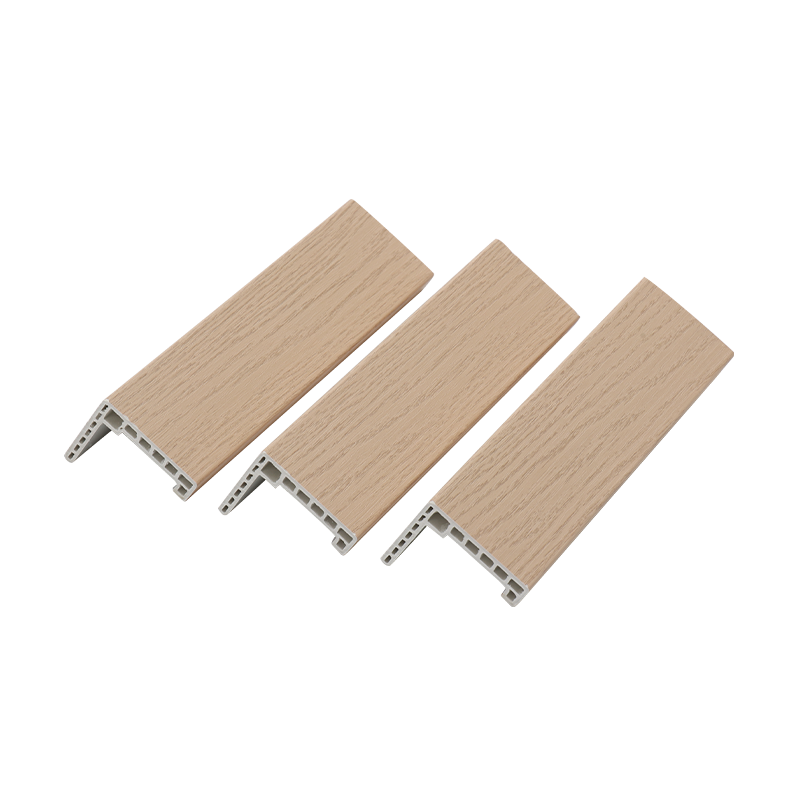 WPC Door Architrave with Waterproof and Fireproof PropertiesThis door architrave matches the water resistance of WPC skirting, protecting door frames from splash and condensation while offering durability and easy installation in wet areas.View Product →
Yes, with a clear limit. MR-MDF survives humid rooms but not continuous direct water contact. Seal every cut edge and the bottom joint with a water-resistant primer, and it will typically hold for five to eight years. Inside or directly beside a shower enclosure, use WPC.
No building material is fully waterproof, but dense WPC with water absorption below 2% behaves as waterproof in practice. It will not swell, delaminate, or rot under daily splash and condensation, which is why it is recommended for shower rooms and utility areas.
MR-MDF is usually 20-35% cheaper per meter, but WPC lasts two to three times longer in wet areas. In a single bathroom, the lifecycle cost of WPC is close to or below MR-MDF once replacement labor is included.
Yes. WPC profiles accept standard interior paints, but prefinished or pigmented boards keep their appearance longer because no site-applied coating is involved.

 English

 English
 عربى
عربى Español