Door frames and architraves are among the most overlooked components in an interior fit-out — until they start to warp, swell, or peel. When that happens in a bathroom, laundry room, or ground-floor corridor, the damage is visible every day and expensive to fix properly because the entire door set has to be dismantled to replace it. Getting the material selection right at the sourcing stage avoids all of that. And for anyone sourcing door components at scale — contractors, developers, hotel fit-out teams, or building material distributors — the choice of material for frames and architraves has a direct impact on project cost, installation speed, and long-term maintenance burden.
This guide covers what WPC door frames and architraves are, how they differ structurally from solid wood and MDF equivalents, what performance characteristics matter for different applications, and what to check when ordering.
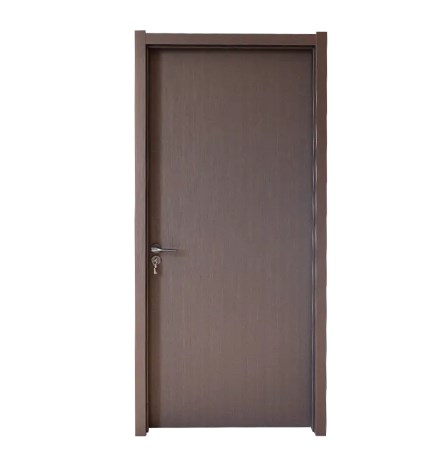
A door frame — also called a door lining or door casing — is the structural surround that lines the door opening in the wall. It has three components: two vertical side jambs and a horizontal head jamb across the top. Together, they provide the fixed reference surface to which the door hinges mount and against which the door closes. The door stop (the rebated or applied strip that the door leaf closes against) is either integrated into the frame or applied separately.
In traditional construction, door frames are solid timber or MDF. Both materials perform adequately in dry interior conditions but have well-documented moisture sensitivity. Timber frames swell when humidity rises and shrink when it drops, causing seasonal sticking and gaps at the head jamb. MDF is even more vulnerable: it absorbs moisture readily at cut edges and around fasteners, swells significantly, and once the surface laminate delaminates, the substrate deteriorates quickly. In bathrooms, laundry rooms, understairs cupboards, ground-floor areas with limited ventilation, or any space with condensation risk, timber and MDF frames commonly show damage within three to five years — sometimes faster.
WPC (wood-plastic composite) door frames address this failure mode directly. The polymer matrix in WPC doesn't absorb water the way wood fibers do, so the dimensional stability in humid environments is fundamentally different: WPC frames don't swell, warp, or delaminate when exposed to moisture that would damage wood or MDF equivalents. This isn't a matter of degree — it's a material property difference that makes WPC the appropriate specification for any application where moisture is a regular factor.
The architrave (also called door casing trim or door surround molding) is the decorative molding that covers the joint between the door frame and the finished wall surface. It runs around the perimeter of the frame on both faces of the wall, hiding the gap between the frame edge and the plaster, drywall, or wall tile. Architraves are not structural — they carry no load — but they're highly visible and define the visual quality of the door set more than any other element. A well-fitted architrave with clean mitered corners makes a door look finished and intentional; a poorly fitted or damaged one makes the entire doorway look cheap.
Because architraves are on the surface and frequently touched — people brush past them, clean around them, and they're often scuffed by furniture and cleaning equipment in commercial settings — they need to be durable as well as visually consistent. In high-traffic applications like hotel corridors, school buildings, and apartment common areas, architraves that chip, dent, or stain readily add recurring maintenance costs to a project that could have been avoided with the right material specification.
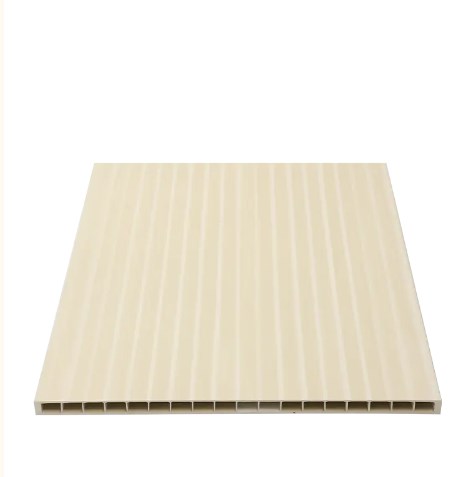
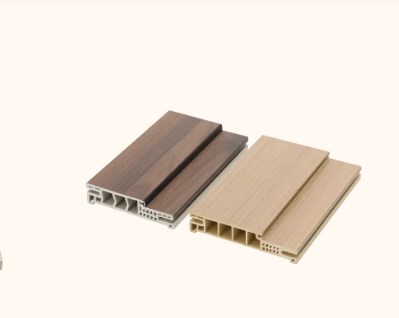
WPC door frames are manufactured by extrusion — the composite material is forced through a die under heat and pressure, producing a continuous profile that's cut to length. The extrusion process means profiles can be produced to precise cross-section dimensions consistently across a production run, and the profile geometry can include functional features like integrated door stops, weatherstrip channels, and snap-fit cover caps as part of the extruded form rather than as separate applied components.
Standard door frame profiles for residential interior applications are designed around wall thickness — the frame jamb depth must match the wall thickness so the frame face sits flush with the finished wall surface on both sides. For single-skin partition walls (typically 75–100mm), standard jamb depths are specified accordingly. For structural walls (typically 150–250mm), wider jamb profiles or adjustable-depth frame systems are used. WPC extrusion can produce frames across this range without the dimensional stability concerns that limit timber in wider-jamb applications.
For commercial applications — hotel rooms, apartment blocks, office partitions — standard door frame sets are typically specified with a rebated frame (where the door stop is integrated into the frame as an extruded rebate) rather than an applied stop. This produces a cleaner visual result and eliminates the common failure point where an applied stop works loose over time and allows gaps to appear at the door face.
WPC architrave profiles are available in a wide range of cross-section styles — from simple square-edge and chamfered profiles suited to contemporary minimalist interiors, to more ornate ogee and ovolo profiles for traditional or transitional design specifications. The profile is consistent along the entire length of every piece because it's extruded to a fixed die, which means the mitered corner joints that terminate the head and leg sections of the architrave always produce a clean match — something that's harder to achieve with hand-planed timber profiles that vary slightly along their length.
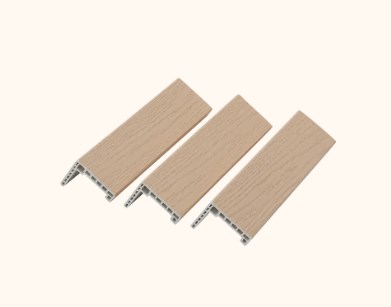
WPC architraves can be finished with a wood-grain surface texture in a range of color options (typically white, cream, oak, walnut, and dark wood tones as standard, with custom finishes available for larger orders). The surface finish is applied during manufacturing — either as an integral color through the composite material, or as a factory-applied film. Unlike painted timber architraves, which require periodic repainting and are vulnerable to chipping at corners, WPC architraves maintain their appearance without painting and resist the corner damage that painted MDF architraves develop in high-traffic areas.
| Property | WPC Frame / Architrave | Solid Timber | MDF (painted or foil-wrapped) |
|---|---|---|---|
| Moisture resistance | Excellent — no swelling, no delamination | Moderate — seasonal movement in humidity changes | Poor — absorbs at cut edges, swells, and delaminates when wet |
| Dimensional stability | Highly consistent profile over service life | Variable — movement with humidity and temperature | Low in humid environments — significant dimensional change |
| Surface durability | Good — resists scuffing and routine impact | Good — can be sanded and refinished | Moderate — surface film chips and peels at edges and corners |
| Maintenance requirement | Low — clean with a damp cloth, no repainting needed | Moderate — periodic sanding and repainting in high-use areas | High in humid environments, surface damage is difficult to repair |
| Installation | Lightweight, cuts cleanly with a standard saw, accepts standard fasteners, and adhesive | Heavier, requires skilled cutting for tight joints | Lightweight, easy to cut, but the edge exposure must be sealed |
| Termite/pest resistance | Resistant — no natural cellulose content to attract pests | Vulnerable — requires treatment in at-risk climates | Moderate — less attractive than solid timber, but not immune |
| Suitable for bathrooms / wet areas | Yes — suitable with normal installation practice | With treated timber only, regular maintenance is required | Not recommended without full sealing of all cut edges and faces |
| Customization | Profile, color, finish, and length to order | Profile and finish; custom sizes available but expensive | Limited profile options; standard sizes widely available |
These are the application areas where the moisture resistance advantage of WPC matters most and where timber and MDF frames most frequently fail. Standard WPC door frames sized to the wall thickness, with WPC architraves on both faces, provide a complete door surround that will outlast the decoration cycle without remedial work. The color and profile choice is driven by the interior design specification — white smooth profiles for contemporary bathrooms, wood-grain profiles for kitchens where the door set should complement cabinetry.
Hotel guestroom and corridor doors require components that maintain appearance through high turnover — daily cleaning with chemical products, guests and luggage making frequent contact with door surrounds, and housekeeping equipment scuffing architraves. WPC profiles withstand this traffic without the surface damage that painted timber or foil-wrapped MDF shows in the same period. For hotel projects, a standard color specification (typically white or a specific wood tone matched to the room design) ordered at volume provides consistent visual results across all rooms. Rebated WPC frames that accept the door set as a complete unit simplify installation and reduce site labor time.
Volume residential development benefits from the combination of consistent dimensions (extruded WPC produces identical profiles across hundreds of units), reduced maintenance liability for property managers, and installation speed. WPC door frame sets with pre-machined hinge and latch positions can be supplied as a ready-to-install package that reduces on-site cutting and fitting time relative to site-cut timber frames.
For anyone placing a specification order for the first time, a few checks prevent the most common problems. Wall thickness should be measured at the actual installation location — not assumed from drawings — because wall buildup after plastering or dry-lining commonly differs from the nominal partition specification. Confirm the jamb depth needed on both sides of the wall before ordering.
Profile matching between frame and architrave is important if the two are sourced from the same manufacturer: confirm that the architrave nose profile is designed to overlay the frame edge cleanly at the correct reveal (the setback distance between the frame edge and the architrave face, typically 5–8mm for residential applications). A mismatch here produces an awkward joint that either leaves a gap or requires the architrave to be forced out of plane.
Surface finish specification should include the gloss level as well as the color — "white" in WPC profiles can range from matt to satin to semi-gloss, and mixing finishes within a project (some frames from one batch, some from another) produces visible color variation that is difficult to correct after installation. Order the full project requirement from a single production run where possible.
Yes, with standard carpentry tools and fixings. WPC profiles cut cleanly with a fine-tooth hand saw or circular saw (the same blades used for PVC trim work produce good results). They can be fixed with standard wood screws, nails, or construction adhesive — the same installation methods used for timber frames. Because WPC doesn't have grain direction like timber, there's no risk of splitting along the grain when fastening near ends, which is a common issue with narrow-section timber components. Miter joints for architrave corners are made in the same way as timber mitres and produce clean, tight joints with the same technique.
Unlike MDF — which must have all cut edges sealed to prevent moisture absorption — WPC does not absorb moisture through cut ends in the same way. The polymer matrix provides inherent resistance at cut surfaces. However, in applications where the frame end grain will be in direct contact with floor tiles or wet floor surfaces (at the base of bathroom door frames, for example), applying a bead of silicone sealant at the frame base is good installation practice. This prevents any capillary action between the frame and the floor surface and maintains the clean visual finish at the floor joint.
In a typical residential bathroom — regular shower steam, condensation on the door surround, intermittent contact with mop water during cleaning — timber door frames (without regular repainting) typically show visible moisture damage (paint peeling, swelling at the base, staining around the latch area) within three to seven years. MDF frames without full edge sealing may show problems within one to three years in the same environment. WPC frames in the same conditions should maintain their appearance and structural integrity for fifteen years or more without remedial maintenance, because the dimensional stability and moisture resistance are material properties rather than protective coatings that can wear away.
WPC Door Frame | WPC Door Architrave | WPC Doors | WPC Door Panel | WPC Skirting | Contact Us

 English

 English
 عربى
عربى Español